
How to treat a muscle strain
The island is pumping with runners everywhere right now. Hyrox has just finished, people are back into pre-season, and it’s honestly awesome to see.
And every single year at this time, we see the same injuries walk through the door at Connect Studio:
Calf strains. Hamstring strains. Quad strains.
Usually resulting from one unfortunate moment:
a sprint you weren’t ready for
a lunge for a ball
a hill you attacked like you were 25 again
an awkward landing
a hard deceleration
And then… bang.
“It felt like someone shot me in the leg.”
“I felt it pull straight away.”
“I can barely walk.”
If you’ve been there, you know the panic. You’re trying to keep it together, you can’t put weight on it properly, and you’ve somehow got to get yourself home.
So instead of the usual mixed advice — ice vs heat, rest vs stretch, “walk it off”, “don’t move”, “take Voltaren”, “don’t take anything” — here’s the simplest, most accurate way to think about it.
The good news? Muscles heal well.
They have an excellent blood supply, and with the right rehab plan, most muscle strains are back to sport in 26–36 days.
Not 12 weeks. Not “see how you go.”
A real, predictable timeframe — if you do the right things at the right time.
The 3-step plan (the one I give patients)
Step 1: Do less than you think for 48–72 hours
Yes — you read that right.
For the first couple of days:
work from home if you can
stay on the couch
move as little as possible
This is Stage 1 of muscle healing: the inflammatory phase.
It lasts around 48–72 hours, and during this phase the muscle hasn’t begun to heal. So the less you do, the less damage.
Also — I usually recommend avoiding anti-inflammatories like Voltaren/Nurofen early, because they can interfere with the strength and quality of early scar formation.
So the rule is simple:
First 3 days: protect it. Don’t test it. Don’t “walk it out.” Don’t stretch it aggressively.
Then we usually aim to see you around Day 4 and start the proper plan.
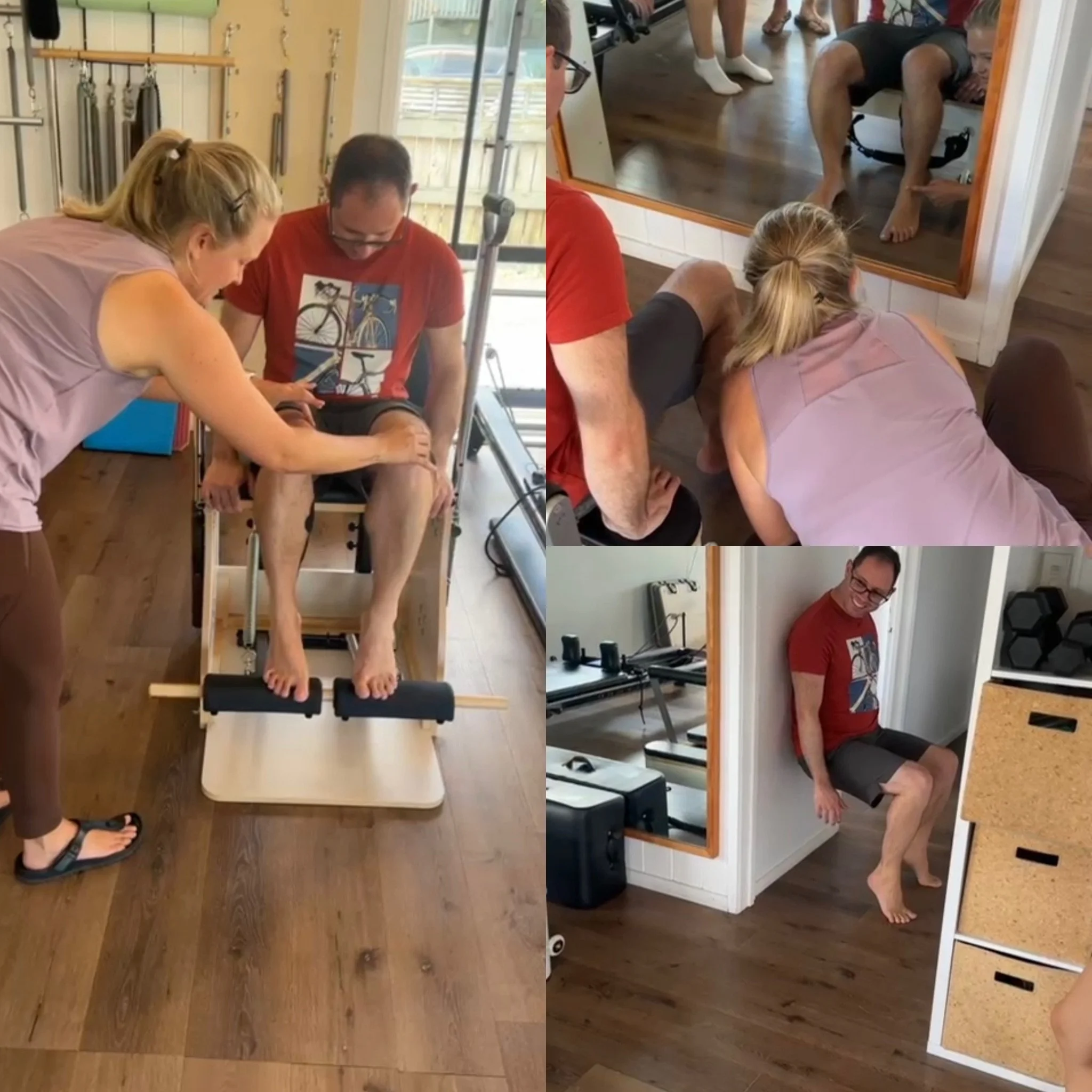
Laura’s husband tore his calf playing beach tennis! Lucky he’s in good hands with our whole Physio crew during inservice!
Step 2: Start rehab early (and make the scar stronger, not just “calm”)
Your muscle heals like a cut. It forms a very light scab (early scar tissue), but that scab is weak — and it stays weak unless we give it the right stimulus.
This is Stage 2: the repair phase (roughly Day 3 to Day 14).
In this phase, your rehab has two goals:
harden and align the scar tissue
keep the injured side as strong as possible so you don’t lose everything while you wait
This is where smart exercise is medicine.
And you’ll notice a pattern:
as the scar strengthens, your walking improves
by around Day 7, most people are walking a lot better
But here’s the trap:
This is the phase where you start to feel good… and you want to train again. But if the tissue isn’t ready for speed, stretch, or load, you’ll do the classic move:
Jump back into full training → it tears again → you’re back to Stage 1 → you restart the clock.
Believe it or not, if you’ve done the first week properly, many people can be jogging before Day 12 (with the right criteria and progression).
Not smashing it — controlled, progressive running exposure.
Step 3: Build “return-to-sport capacity” (full range + load + speed)
Once you hit the next stage, we don’t just aim for “pain-free.”
We aim for match-ready tissue.
This is where rehab becomes more athletic:
loading on one leg
strength through full range
controlled stretching under load
running progressions
hopping and jumping
change of direction work (if your sport demands it)
This is where the tissue remodels and aligns properly so it doesn’t keep going again.
And this is the big concept most people miss:
Muscles don’t heal best through rest. They heal best through the right load.
Mechanotherapy (mechanotransduction) is the driver.
I’ve seen muscles that were “rested” for 3 months look basically unchanged compared with someone who did quality rehab for 12 days.
Rest makes pain settle. Loading makes tissue resilient.
The bottom line…
If you strain a muscle — even a bad one — it’s actually one of the better injuries to get.
Because muscles:
have a great blood supply
respond fast to a smart program
and heal in a predictable window
Do the work and you can realistically aim for:
26–36 days back to sport with a proper rehab plan
So if you’ve been putting off getting it checked, or if you know someone who’s limping around saying “it’ll be fine”…Send this to them!
Because the difference between a muscle strain that heals once and a muscle strain that keeps recurring for months usually comes down to one thing:
Did you respect the first 72 hours… and then did you rehab it properly?
Cheers
Nick